

Why is the project
necessary
The international competitiveness of Latvian higher education institutions is limited — no university currently ranks among the top 1,000 in global rankings, the brain drain of top graduates is increasing, and fewer than half of students complete their bachelor’s programmes. The rapid development of digital technologies — particularly artificial intelligence — as well as systemic reforms, create a need for significant modernisation of the study process.
SPD addresses these challenges by developing unified shared solutions covering study management, library access, internship organisation, quality assessment, and personal data management. These solutions will enable students to design their learning paths more flexibly, while allowing higher education institutions to make data-driven decisions and collaborate more effectively at the national and European levels.
The project supports Latvia’s participation in European digital education initiatives, including digital diplomas and data exchange platforms, and lays a long-term foundation for lifelong learning and preparing a competitive workforce to meet the changing demands of the labour market.


Why is the project
necessary
The international competitiveness of Latvian higher education institutions is limited — no university currently ranks among the top 1,000 in global rankings, the brain drain of top graduates is increasing, and fewer than half of students complete their bachelor’s programmes. The rapid development of digital technologies — particularly artificial intelligence — as well as systemic reforms, create a need for significant modernisation of the study process.
SPD addresses these challenges by developing unified shared solutions covering study management, library access, internship organisation, quality assessment, and personal data management. These solutions will enable students to design their learning paths more flexibly, while allowing higher education institutions to make data-driven decisions and collaborate more effectively at the national and European levels.
The project supports Latvia’s participation in European digital education initiatives, including digital diplomas and data exchange platforms, and lays a long-term foundation for lifelong learning and preparing a competitive workforce to meet the changing demands of the labour market.
Work Packages
Competency Development
Objective and Activities
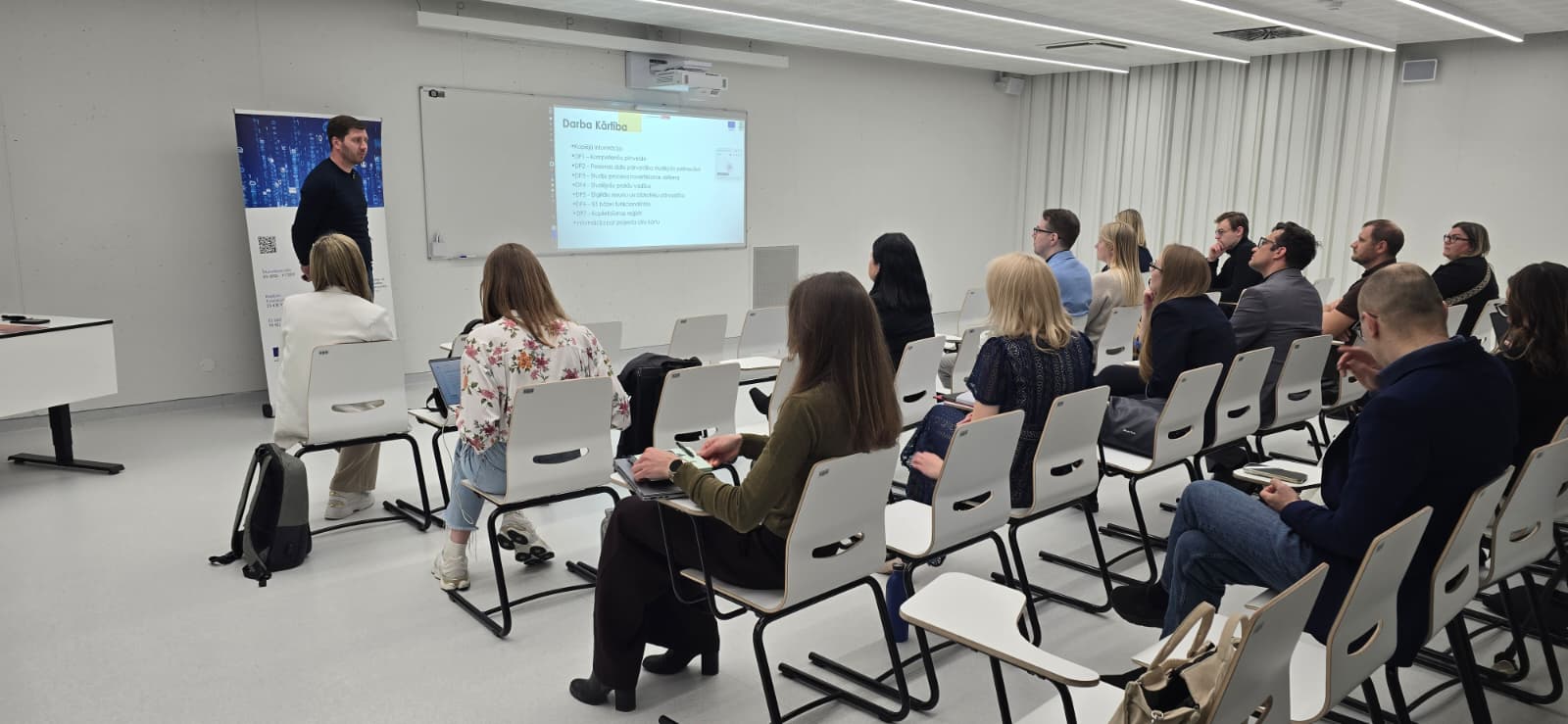
The objective of this work package (WP) is to ensure that the administrative staff at AII are prepared to use and maintain all digital solutions developed within the framework of the other work packages. Training will cover three areas: modern study process models (flexible learning paths, student-centered approaches), digital transformation management skills (change management, using data for decision-making, cybersecurity), and the exchange of best practices among higher education institutions regarding specific digitalization solutions. The training will take place in various formats—lectures, workshops, online courses—both within each higher education institution, during joint events, and during study tours to foreign higher education institutions with similar systems. Participants’ knowledge will be assessed both at the beginning and at the end of the training.
Result
This work package will ensure that the project’s digital solutions are not only technically implemented but also actually used in day-to-day work. Administrative staff at Latvian universities will gain practical skills for working with the new systems and an understanding of the broader principles of digital transformation. A mechanism for sharing best practices will ensure that universities do not have to reinvent the wheel individually—knowledge and experience will be compiled and shared with all participating institutions.
Related Documents
Application Criteria

Personal Data Management in Student Research
Objective and Activities
The objective of this work package (WP) is to procure and implement a unified digital platform that enables AII to legally and transparently collect, process, and manage the personal data of research participants in accordance with the European General Data Protection Regulation (GDPR). In practice, this means that students, faculty, and researchers will be able to digitally manage informed consent processes—specifying who has authorized the use of their data, by whom, and for what purposes—with a complete audit trail. The platform will also include data collection tools: surveys, questionnaires, and clinically validated forms that can be created without any programming knowledge. Different users—such as researchers, data protection specialists, data curators, and administrative staff—will be granted different access rights according to their roles.
Result
The work package will ensure that all higher education institutions in Latvia can conduct research involving human data in a legally compliant and transparent manner, without the risk of violating data protection requirements. Researchers will gain a convenient, unified tool for data collection and consent management. Data protection specialists and management at higher education institutions will gain an overview and control mechanisms over all active research projects. Overall, the system will reduce legal risk, accelerate the launch of research projects, and improve the quality and reliability of academic research.

Study Process Evaluation System
Objective and Activities
The objective of this work package (WP) is to create a unified digital survey system that allows for the regular and structured assessment of the quality of studies at all higher education institutions in Latvia. The new system will provide both common, national-level surveys on study programs and the ability for each institution to create its own surveys on courses, instructors, internships, and support services. The system will be linked to study program and course registries as well as student records so that surveys automatically reach the right respondents at the right time. Implementation will take place in two phases: first, program-level surveys will be introduced at all higher education institutions, followed by more specific surveys and the inclusion of the remaining higher education institutions.
Result
The work package will create a reliable, comparable data source on the quality of higher education in Latvia—accessible to higher education institutions, industry organizations, and the public in accordance with each party’s access rights. Higher education institutions will receive automated reports and the ability to respond promptly to student feedback. At the national level, it will become possible to monitor the quality of higher education systematically and transparently, rather than relying on data compiled differently by each institution.

Student Internship Management
Purpose and actions
The aim of this work package (WP) is to create a single digital system that brings together all participants in the internship process – students, universities and employers – in one transparent environment. The new system will cover the entire internship cycle: employers publish internships, students search for and apply for them, contracts are prepared and signed electronically, and the internship progress is monitored and evaluated digitally. The system will also support international internships, including the Erasmus+ programme, and will be compatible with European data exchange standards.
Result:
The work package will provide practical benefits to all parties involved. Employers will be able to post internship offers in one place, reaching Latvian universities immediately. Students will gain a transparent way to search for, select, and apply for internships, as well as track their assignments and evaluations. Higher education institutions will receive automated reports and real-time overviews of the progress of internships. Overall, the system will reduce the bureaucratic burden, increase the transparency of the process, and improve the monitoring of internship quality, including mutual evaluation, where students evaluate their internship sites and employers evaluate the students.

Digital Resource and Library Management
Objective and Activities
The objective of this work package (WP) is to create a modern, shared digital platform that brings together the resources of all Latvian university libraries—including physical collections, e-books, subscription databases, scholarly publications, and other online materials—into a single, easily accessible environment. Students and faculty will be able to search for and access all resources necessary for their studies in one place, regardless of which university they are located at. Alongside the student experience, the libraries’ internal operations will also be modernized—including resource acquisition, license management, data exchange with the national library’s union catalog, and integration with universities’ academic, accounting, and research management systems. Implementation will take place gradually: first, the system will be piloted at the project’s partner universities, after which the opportunity to join will be offered to all other universities.
Result
This work package will create a shared, modular library management system that each university can adapt to its own needs or use in a shared mode with others. Students will gain easy access to all academic resources in one place, supported by search and artificial intelligence. University libraries will benefit from automated workflows, shared licensing models, and data analysis tools for evaluating resource usage. The system will be compatible with Latvian and international library data standards, ensuring broad collaboration even beyond the higher education sector.

Core SIS Functionality
Objective and Activities
The objective of this work package (WP) is to develop a national-level reference architecture —a practical set of templates and modules that Latvian higher education institutions can use to modernize their student information systems (SIS). In collaboration with international consultants and as many Latvian higher education institutions as possible, a detailed map of study processes—from admission to graduation—will be developed, on the basis of which ready-to-use, interoperable system modules will be configured. These modules will cover both traditional study processes and newer needs: lifelong learning and flexible and interdisciplinary study paths. In parallel with system development, targeted training sessions will be organized for administrative staff, faculty, and students, both in person and online.
Result
The work package will create a shared, open “library” of modules that each university can freely use and adapt to its own needs, and any improvement made by one university will become available to all others. As a result, universities will be able to fully transition to digital document management, automatically exchange academic data with one another and with national registries, and offer students a more flexible academic experience, including the option to take courses at other universities. The system will also be compatible with European data exchange standards, allowing Latvian universities to integrate into a broader international digital space.

Shared Registers
Objective and Activities
The objective of this work package (WP) is to create a centralized digital infrastructure in which all higher education institutions in Latvia store and exchange standardized information, such as study program and course catalogs, student records, diplomas, and other data. Higher education institutions transfer verified data from their study information systems to shared registries, and any changes are automatically recorded and stored. Activities include integration with higher education institutions’ systems at all key stages of study—admissions, study planning, credit transfer, and electronic diploma issuance—as well as the development of common data and process standards to ensure that information exchange occurs as automatically as possible and without manual intervention. Technically, the solution is being built on the basis of the national digital infrastructure (LVRTC, VDAA), utilizing existing connections to national registries.
Result
The work package will create a practical “one-stop shop” for both students and graduates (e.g., diploma access management) and for higher education institutions (the ability to obtain data on students who have studied at another institution), as well as for external users and systems (employers, government agencies). The system will ensure that all academic data in Latvia is available in one place, interoperable, and reliable, without duplication or manual data transfer between institutions.

Work Packages
Competency Development
Objective and Activities
The objective of this work package (WP) is to ensure that the administrative staff at AII are prepared to use and maintain all digital solutions developed within the framework of the other work packages. Training will cover three areas: modern study process models (flexible learning paths, student-centered approaches), digital transformation management skills (change management, using data for decision-making, cybersecurity), and the exchange of best practices among higher education institutions regarding specific digitalization solutions. The training will take place in various formats—lectures, workshops, online courses—both within each higher education institution, during joint events, and during study tours to foreign higher education institutions with similar systems. Participants’ knowledge will be assessed both at the beginning and at the end of the training.
Result
This work package will ensure that the project’s digital solutions are not only technically implemented but also actually used in day-to-day work. Administrative staff at Latvian universities will gain practical skills for working with the new systems and an understanding of the broader principles of digital transformation. A mechanism for sharing best practices will ensure that universities do not have to reinvent the wheel individually—knowledge and experience will be compiled and shared with all participating institutions.
Related Documents
Application Criteria
Personal Data Management in Student Research
Objective and Activities
The objective of this work package (WP) is to procure and implement a unified digital platform that enables AII to legally and transparently collect, process, and manage the personal data of research participants in accordance with the European General Data Protection Regulation (GDPR). In practice, this means that students, faculty, and researchers will be able to digitally manage informed consent processes—specifying who has authorized the use of their data, by whom, and for what purposes—with a complete audit trail. The platform will also include data collection tools: surveys, questionnaires, and clinically validated forms that can be created without any programming knowledge. Different users—such as researchers, data protection specialists, data curators, and administrative staff—will be granted different access rights according to their roles.
Result
The work package will ensure that all higher education institutions in Latvia can conduct research involving human data in a legally compliant and transparent manner, without the risk of violating data protection requirements. Researchers will gain a convenient, unified tool for data collection and consent management. Data protection specialists and management at higher education institutions will gain an overview and control mechanisms over all active research projects. Overall, the system will reduce legal risk, accelerate the launch of research projects, and improve the quality and reliability of academic research.
Study Process Evaluation System
Objective and Activities
The objective of this work package (WP) is to create a unified digital survey system that allows for the regular and structured assessment of the quality of studies at all higher education institutions in Latvia. The new system will provide both common, national-level surveys on study programs and the ability for each institution to create its own surveys on courses, instructors, internships, and support services. The system will be linked to study program and course registries as well as student records so that surveys automatically reach the right respondents at the right time. Implementation will take place in two phases: first, program-level surveys will be introduced at all higher education institutions, followed by more specific surveys and the inclusion of the remaining higher education institutions.
Result
The work package will create a reliable, comparable data source on the quality of higher education in Latvia—accessible to higher education institutions, industry organizations, and the public in accordance with each party’s access rights. Higher education institutions will receive automated reports and the ability to respond promptly to student feedback. At the national level, it will become possible to monitor the quality of higher education systematically and transparently, rather than relying on data compiled differently by each institution.
Student Internship Management
Purpose and actions
The aim of this work package (WP) is to create a single digital system that brings together all participants in the internship process – students, universities and employers – in one transparent environment. The new system will cover the entire internship cycle: employers publish internships, students search for and apply for them, contracts are prepared and signed electronically, and the internship progress is monitored and evaluated digitally. The system will also support international internships, including the Erasmus+ programme, and will be compatible with European data exchange standards.
Result:
The work package will provide practical benefits to all parties involved. Employers will be able to post internship offers in one place, reaching Latvian universities immediately. Students will gain a transparent way to search for, select, and apply for internships, as well as track their assignments and evaluations. Higher education institutions will receive automated reports and real-time overviews of the progress of internships. Overall, the system will reduce the bureaucratic burden, increase the transparency of the process, and improve the monitoring of internship quality, including mutual evaluation, where students evaluate their internship sites and employers evaluate the students.
Digital Resource and Library Management
Objective and Activities
The objective of this work package (WP) is to create a modern, shared digital platform that brings together the resources of all Latvian university libraries—including physical collections, e-books, subscription databases, scholarly publications, and other online materials—into a single, easily accessible environment. Students and faculty will be able to search for and access all resources necessary for their studies in one place, regardless of which university they are located at. Alongside the student experience, the libraries’ internal operations will also be modernized—including resource acquisition, license management, data exchange with the national library’s union catalog, and integration with universities’ academic, accounting, and research management systems. Implementation will take place gradually: first, the system will be piloted at the project’s partner universities, after which the opportunity to join will be offered to all other universities.
Result
This work package will create a shared, modular library management system that each university can adapt to its own needs or use in a shared mode with others. Students will gain easy access to all academic resources in one place, supported by search and artificial intelligence. University libraries will benefit from automated workflows, shared licensing models, and data analysis tools for evaluating resource usage. The system will be compatible with Latvian and international library data standards, ensuring broad collaboration even beyond the higher education sector.
Core SIS Functionality
Objective and Activities
The objective of this work package (WP) is to develop a national-level reference architecture —a practical set of templates and modules that Latvian higher education institutions can use to modernize their student information systems (SIS). In collaboration with international consultants and as many Latvian higher education institutions as possible, a detailed map of study processes—from admission to graduation—will be developed, on the basis of which ready-to-use, interoperable system modules will be configured. These modules will cover both traditional study processes and newer needs: lifelong learning and flexible and interdisciplinary study paths. In parallel with system development, targeted training sessions will be organized for administrative staff, faculty, and students, both in person and online.
Result
The work package will create a shared, open “library” of modules that each university can freely use and adapt to its own needs, and any improvement made by one university will become available to all others. As a result, universities will be able to fully transition to digital document management, automatically exchange academic data with one another and with national registries, and offer students a more flexible academic experience, including the option to take courses at other universities. The system will also be compatible with European data exchange standards, allowing Latvian universities to integrate into a broader international digital space.
Shared Registers
Objective and Activities
The objective of this work package (WP) is to create a centralized digital infrastructure in which all higher education institutions in Latvia store and exchange standardized information, such as study program and course catalogs, student records, diplomas, and other data. Higher education institutions transfer verified data from their study information systems to shared registries, and any changes are automatically recorded and stored. Activities include integration with higher education institutions’ systems at all key stages of study—admissions, study planning, credit transfer, and electronic diploma issuance—as well as the development of common data and process standards to ensure that information exchange occurs as automatically as possible and without manual intervention. Technically, the solution is being built on the basis of the national digital infrastructure (LVRTC, VDAA), utilizing existing connections to national registries.
Result
The work package will create a practical “one-stop shop” for both students and graduates (e.g., diploma access management) and for higher education institutions (the ability to obtain data on students who have studied at another institution), as well as for external users and systems (employers, government agencies). The system will ensure that all academic data in Latvia is available in one place, interoperable, and reliable, without duplication or manual data transfer between institutions.
Project Objectives
Each task forms part of a shared digital infrastructure that, in the long term, transforms the way Latvian higher education institutions manage their study processes.
Achievable outcomes
A unified, modern, and interconnected digital infrastructure for the study process, supporting the competitiveness of Latvian higher education.