
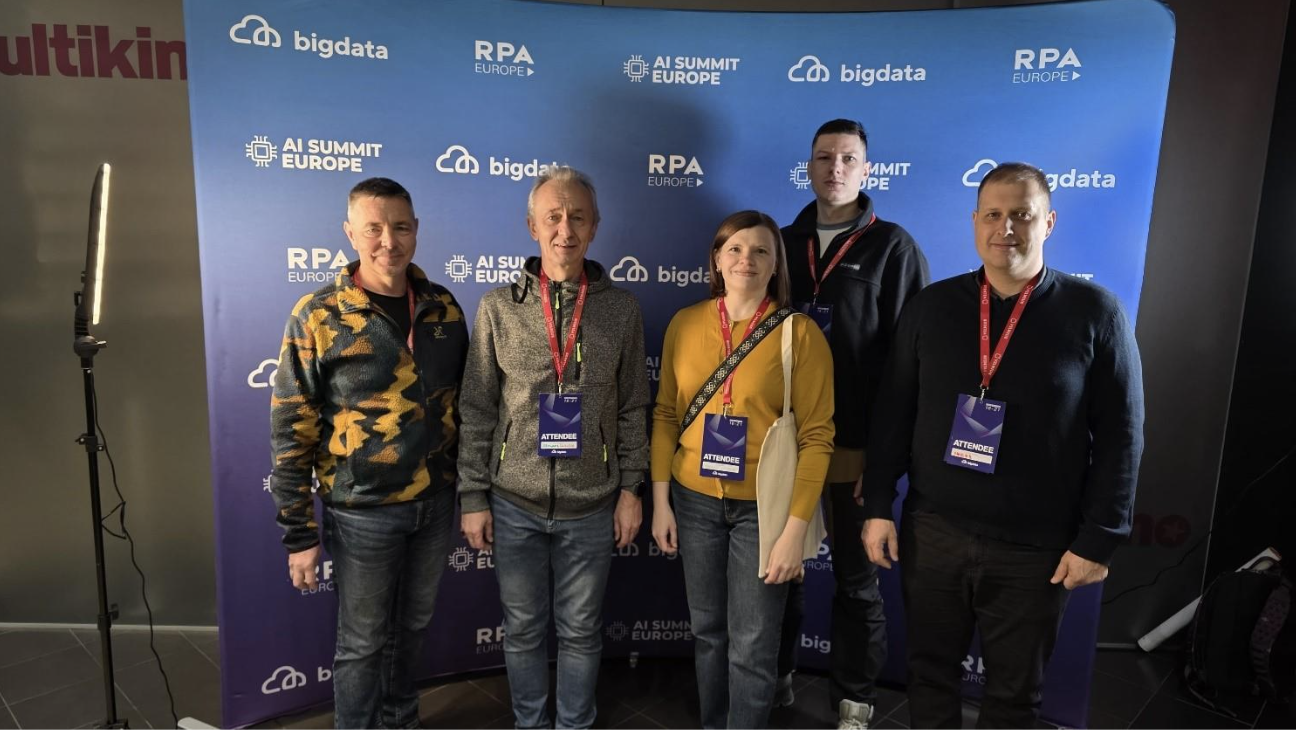
From November 17 to 21, the Big Data Conference Europe 2025 took place in Vilnius, Lithuania, which was also attended by five Latvian data stewards: Oksana Zaiceva from Riga Technical University and Ilmārs Dukulis, Ingus Šmits, Jānis Judrups and Nikolajs Būmanis from the Latvia University of Life Sciences and Technology.
The conference brought together more than 60 speakers and 700 participants from dozens of countries and covered a wide range of topics – from data quality and governance to artificial intelligence (AI) agents, automation, data platforms and digital transformation of organisations.
In total, the conference held seven practical workshops, two of which emphasised the use of AI in practice. The workshop AI For Leaders: Turn Chaos into Clarity – A Get-it-Done Game Plan for Leaders Who Want Results Yesterday provided an opportunity to look at AI initiatives from a management perspective – how to distinguish flashy experiments from projects with clear business impact and how to define a 3-6 month roadmap for the first initiatives. Meanwhile, the workshop Analyse your workflows and upgrade them with AI mapped your real workflow stages and identified opportunities to replace manual, time-consuming steps with automation or AI assistants without involving programming.
Key takeaways from the conference:
- Data quality determines the success of AI projects. If data is inconsistent, inaccurate, or incomplete, AI systems will fail, and their results will not be reproducible, which is why AI projects are often not implemented beyond the pilot stage. Data quality control should be a continuous process with clear metrics and transparent tests, both in production systems and in research datasets and study projects.
- Data contracts provide a solid foundation for AI ecosystems. They define clear rules about data structure, quality and delivery responsibility between teams and systems. This significantly reduces errors in data flows and allows everyone to work with a common understanding of the data. As a result, AI solutions become more stable and easier to maintain. Data stewards should promote the development and implementation of these contracts. The idea of such contracts is also useful in research projects and course development so that the terms of data use are clear from the beginning.
- Metadata management and data provenance tracking are critical for modern AI solutions. Without organised metadata, AI systems cannot understand context or interpret data correctly. RAGs, AI agents, and personalised learning paths rely on clearly defined data semantics and a trusted data catalogue. This applies equally to organisational data platforms, research data repositories and data used in training examples.
- AI projects often fail because of data accuracy, not technology. Organisations often focus on models and tools, forgetting to organise data flows and responsibilities. As a result, poor-quality, unprepared data is delivered to AI, which makes solutions unreliable.
- AI initiatives should start with a clearly defined problem. If the project starts from a tool rather than a problem, AI results are fragmented and of little value. A properly defined problem and linkage to KPIs or other measurements allows you to choose the most appropriate approach and accurately measure the benefits.
- AI must be made accessible to non-technical employees to realise its full value. If AI is used only by technical teams, the organisation loses most of the potential benefit. The role of data stewards is to ensure that these tools are connected to the correct and understandable data sources, as well as to define safe boundaries for use.
- Prompt guidelines and standards are essential at the organisational level. Without common principles, AI results are inconsistent and difficult to control. Common guidelines ensure quality, repeatability, and productivity. They should be viewed as official, living documentation. Properly formulated prompts allow for the effective use of AI tools for data classification, metadata generation, and content summaries.
- AI agents only work reliably when processes and data are clearly defined. Agents rely on precise APIs, documents, and data structures, so chaotic data and informal “detours” directly translate into erroneous behaviour.
- Developing people skills is essential to realising the value of AI. Even the most advanced AI tool cannot deliver value if teams don’t know how to work with it and how to interpret the results. Training and hands-on experience are critical productivity accelerators. Data stewards and researchers can become knowledge carriers here – demonstrating good practices, examples, and limitations to consider when working with data and AI.
- AI should be integrated into product and service logic as a strategic element. When AI is used only as an “additional function”, its potential is not realised. Effective companies build AI as a central component of business value, not a cosmetic improvement. This ensures scalability and long-term competitiveness. For data stewards and researchers, this means thinking of data and models not just as a resource, but as part of specific products and services.
Overall, the conference content leads to the conclusion that AI projects are not limited to models and platforms, but are based on the people who develop them, whose task is first and foremost to introduce order into data, procedures, and the distribution of responsibilities. Data stewards, researchers, and academics together promote such order, clarity, and security of data.